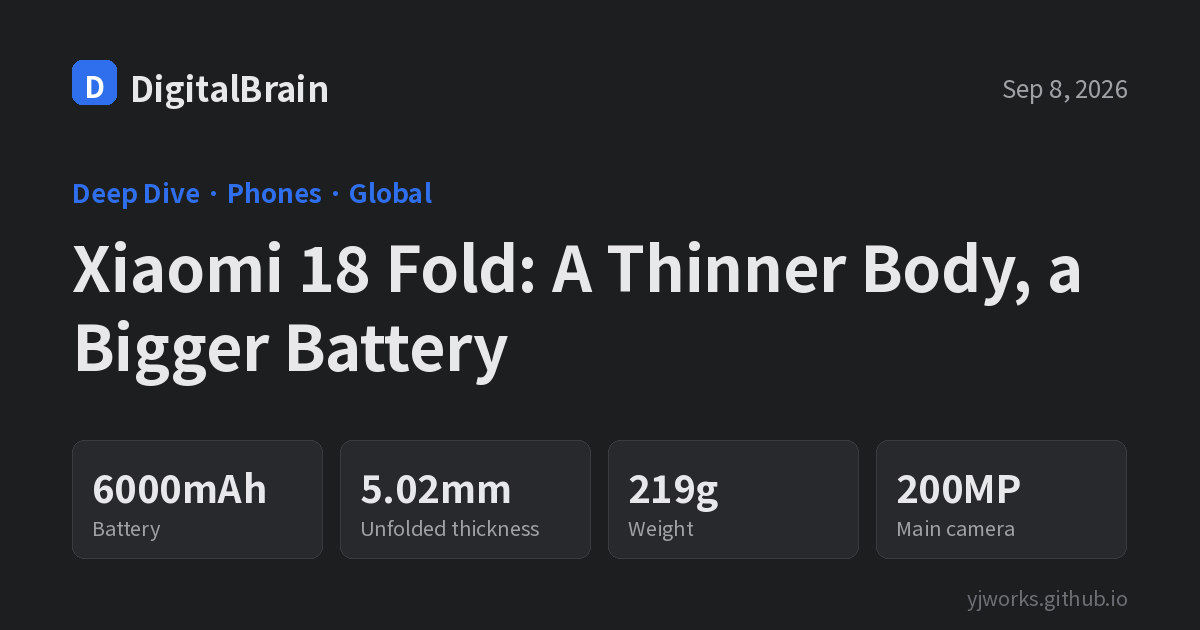
Xiaomi officially unveiled its first wide-format book-style foldable, the Xiaomi 18 Fold, in China on September 7. Built around an in-house chip, a Leica-tuned triple camera, and a 6000mAh battery, it’s a direct challenge to the big-foldable segment Samsung’s Galaxy Z Fold line has held for years.
Big foldables have improved steadily since the category started, but two numbers barely moved: battery capacity and folded thickness. Samsung’s Galaxy Z Fold line has shipped with roughly the same 4400mAh cell since the Z Fold3, and most rivals in the segment have stayed in that same range because the folding hinge and dual-screen stack leave little room for a bigger cell. The Xiaomi 18 Fold is the first phone in the category to break that pattern this decisively, pairing a much larger battery with a body that’s actually thinner than most non-folding flagship phones when unfolded.
Xiaomi 18 Fold
| Spec | Detail |
|---|---|
| Cover display | 5.38-inch AMOLED, 1712×1168, 120Hz |
| Inner display | 7.58-inch flexible AMOLED, 2364×1672, 120Hz |
| Chipset | Xring O3 (Xiaomi in-house, 10-core CPU / 16-core GPU) |
| Memory | Up to 16GB RAM; the 1TB variant uses LPDDR6 |
| Cameras | Leica-tuned, 200MP main + 50MP ultrawide + 50MP periscope telephoto |
| Battery | 6000mAh |
| Thickness | 5.02mm unfolded / 10.68mm folded |
| Weight | 219g |
| Price (China) | 16GB+512GB ¥12,999, 16GB+1TB ¥14,999, ceramic 16GB+1TB ¥15,999 |
| Sales start | September 10 (China) |
The base configuration starts at ¥12,999. Whether the phone will reach markets outside China, including Korea, has not been confirmed. The Xring O3 chip is notable on its own: it’s Xiaomi’s own silicon rather than a licensed Qualcomm or MediaTek part, and the 1TB configuration is among the first phones anywhere to pair it with LPDDR6 memory, a generation ahead of the LPDDR5X still used in most 2026 flagships. Neither the chip’s real-world performance nor its thermal behavior inside a folding chassis — where heat has less room to dissipate than in a slab phone — has been independently benchmarked yet.
Rival comparison: Galaxy Z Fold7
| Spec | Xiaomi 18 Fold | Galaxy Z Fold7 |
|---|---|---|
| Cover display | 5.38-inch, 120Hz | 6.5-inch FHD+, 120Hz |
| Inner display | 7.58-inch, 120Hz | 8.0-inch QXGA+, 120Hz |
| Chipset | Xring O3 (in-house) | Snapdragon 8 Elite for Galaxy |
| Battery | 6000mAh | 4400mAh |
| Main camera set | 200MP + 50MP ultrawide + 50MP tele | 200MP + 12MP ultrawide + 10MP tele |
| Thickness (unfolded) | 5.02mm | TBC |
| Weight | 219g | TBC |
| Starting price | ¥12,999 (China) | $1,999 (US) |
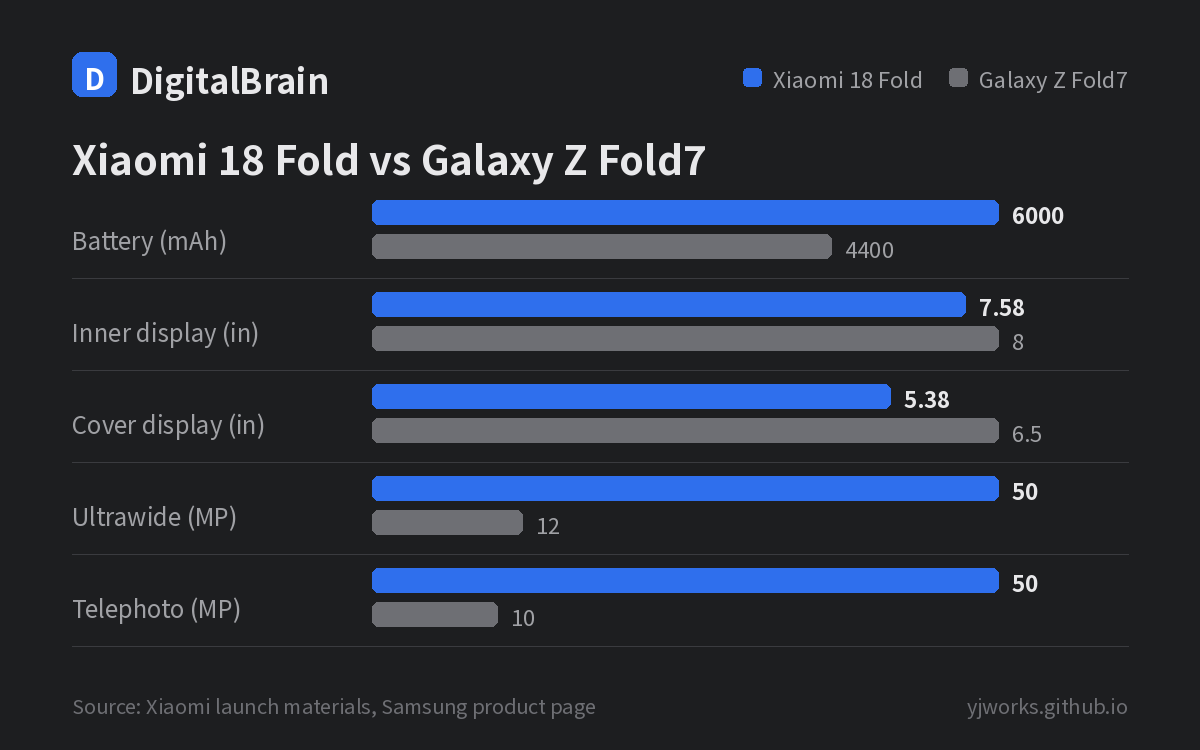
On paper, the Xiaomi 18 Fold leads on battery capacity and camera resolution. But the Galaxy Z Fold7 is already sold in multiple markets with Samsung’s water/dust-resistance certification and established after-sales support, while the Xiaomi 18 Fold’s launch so far is China-only, with no global distribution or service network confirmed yet.
The camera gap is worth a closer look. Both phones use a 200MP main sensor, but the Xiaomi 18 Fold pairs it with a 50MP ultrawide and a 50MP periscope telephoto, versus the Galaxy Z Fold7’s 12MP ultrawide and 10MP telephoto. On paper that’s a meaningful jump in resolution for the two secondary lenses, though resolution alone doesn’t settle image quality — sensor size, lens aperture, and Xiaomi’s Leica color tuning versus Samsung’s own processing pipeline all matter, and neither camera has been tested side by side yet. The battery gap is more straightforward: 6000mAh against 4400mAh is a roughly 36% increase, which should translate into a noticeably longer day of use, assuming the Xring O3 chip doesn’t offset the gain with higher power draw.
Strengths and weaknesses
Strengths
- A 6000mAh battery is a big jump for a big foldable, a segment that has been stuck near 4400mAh.
- At 5.02mm unfolded, it’s slimmer than most phones in its class.
- The Leica triple-camera setup is unusually capable for a foldable.
Weaknesses
- No confirmed plan for global or Korean availability, so purchase access is uncertain for most readers.
- Water-resistance rating and hinge-durability certification are absent from the launch materials and remain unverified.
- Real-world performance and thermals of the new in-house Xring O3 chip haven’t been benchmarked independently yet.
Who it’s for: buyers in China who want the biggest battery and thinnest body currently available in a foldable will find this an easy pick. Buyers elsewhere who value confirmed water resistance, hinge durability, and local after-sales support are still better served by the Galaxy Z Fold7 for now.
Korea availability
No Korean launch plan for the Xiaomi 18 Fold has been confirmed (TBC). Xiaomi’s foldable lineup has so far stayed centered on the domestic Chinese market.
Verdict
The Xiaomi 18 Fold tackles two of the foldable category’s long-standing weak points — battery size and thickness — in one device, and on spec sheets it beats the Galaxy Z Fold7 in several areas. But global distribution and durability verification are still open questions, so it’s worth waiting for an official international launch before treating it as a buying option.
Sources: