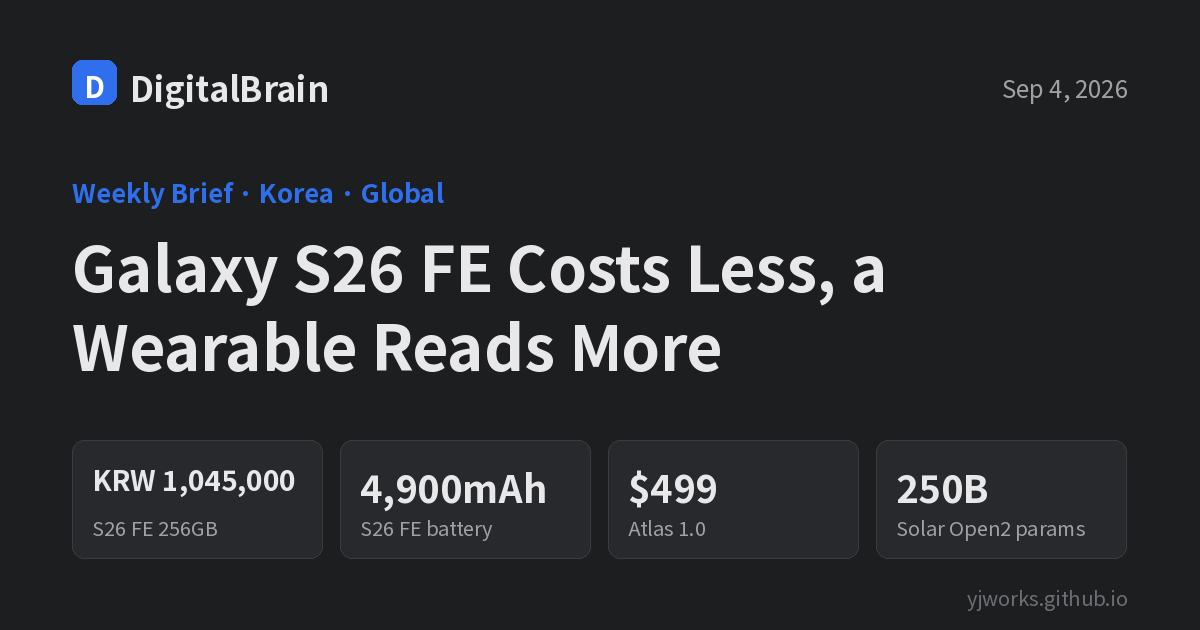
On the last day of the first week of September, Samsung’s Galaxy S26 FE officially went on sale in Korea. Abroad, a brainwave-reading wearable called Atlas 1.0 already started shipping, and in software, Upstage’s large open model Solar Open2-250B was the talk of the week. None of the three is a dramatic leap on its own, but together they sketch where each part of the market is spending its effort right now: Samsung repackaging known hardware at a lower price, a small hardware maker pushing into an unproven sensor category, and Korean AI labs racing to field their own large open models alongside global names. Links to this week’s earlier deep dives on an embedded board, a GitHub pick, and a wearable are collected at the bottom.
Korea
Samsung Galaxy S26 FE
- Chipset: Exynos 2500
- Memory/storage: 8GB RAM, 128GB or 256GB
- Display: 6.7-inch AMOLED, 2340×1080, 120Hz
- Cameras: 50MP main + 8MP ultrawide + 8MP 3x telephoto (rear), 12MP (front)
- Battery: 4,900mAh
- Build: 161.6×76.9×7.4mm, aluminum frame, IP68
- Colors: Blueberry, Graphite, Pistachio
- Price: KRW 1,045,000 for 256GB (128GB price TBC)
- Release: unveiled August 27, on sale in Korea from September 4 through Samsung Store, Samsung.com, and carrier stores
- Take: an Exynos 2500 and 8GB of RAM is the same combination the mainline Galaxy S series already shipped last year, so the FE is doing exactly what an FE is supposed to do — selling last year’s flagship at today’s price. Keeping IP68 and an aluminum frame while dropping into the low-1-million-won range is the actual news here; this is a phone for buyers prioritizing durability and price over the newest camera or AI features. The triple rear camera setup (50MP main, 8MP ultrawide, 8MP 3x telephoto) also matches last year’s tier rather than this year’s flagship, which is consistent with how Samsung has positioned every FE model since the line started: recent flagship silicon and design, but camera hardware and RAM held back a generation to hit a lower price point.
- Sources: 9to5Google, GSMArena, Edaily, Gukje News
Global
Atlas 1.0 (Brain Wearable)
- Category: EEG-based wearable
- Price: $499
- Release: went on sale September 1 (local time)
- Sensor channel count, battery life, companion app, and data-processing approach: TBC
- Take: consumer EEG wearables are still an unproven category — accuracy claims and real use cases haven’t been independently verified yet. A $499 price tag alone doesn’t tell you whether this is a genuine multi-channel EEG device or a simplified focus-tracking gadget, so the specs are worth treating with caution until hands-on reviews and clinical backing show up. The broader pattern worth watching is that “brain wearables” keep launching at consumer price points well before the underlying signal-processing claims get third-party validation — the same caution that applied to earlier sleep- and focus-tracking headbands applies here.
- Source: Gear Patrol
Software
Solar Open2-250B (Upstage)
- Developer: Upstage (South Korea)
- Scale: 250B parameters (per the model name)
- Purpose: high-performance enterprise reasoning, open deployment
- License, exact release date, and benchmark numbers: TBC
- On-device: a 250B-class model can’t run on a laptop or edge device even in a quantized form — it assumes server or cloud deployment with multiple accelerators, which puts it in a different bracket from the smaller on-device models this blog usually covers on Thursdays
- Take: this week saw a wave of large open models land at once. Z.ai’s GLM-5.2 is drawing attention as a mixture-of-experts model tuned for coding, math, and agent tasks; DeepSeek-V4-Flash is being adopted for low-latency assistants and coding tools; and Moonshot AI’s Kimi-K3 is positioned for long-context, document-heavy RAG pipelines. Among that group, Upstage’s entry is the one most likely to show up in Korean enterprise software stacks, given the company’s existing customer base here. Adoption decisions should still wait until the license and real benchmark numbers are confirmed — a parameter count in a model’s name is not a substitute for an independent evaluation.
- Source: Tech AI Magazine
This Week at a Glance
| Product | Category | Region | Key specs | Price | Release |
|---|---|---|---|---|---|
| Galaxy S26 FE | Smartphone | Korea | Exynos 2500, 6.7", 4,900mAh | KRW 1,045,000 (256GB) | Sep 4 |
| Atlas 1.0 | AI wearable | Global | EEG-based sensor | $499 | Sep 1 |
| Solar Open2-250B | Open-source LLM | Software | 250B parameters | Open model | TBC |